The All Important Wreath
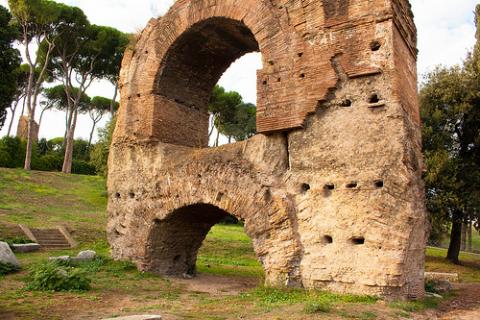
It was an ancient tradition, that when the Capitol was founded by one of the Roman kings, the god Terminus (who presided over boundaries, and was represented, according to the fashion of that age, by a large stone) alone, among all the inferior deities, refused to yield his place to Jupiter himself. A favorable inference was drawn from his obstinacy, which was interpreted by the augurs as a sure presage that the boundaries of the Roman power would never recede.28 During many ages, the prediction, as it is usual, contributed to its own accomplishment. But though Terminus had resisted the Majesty of Jupiter, he submitted to the authority of the emperor Hadrian.29 The resignation of all the eastern conquests of Trajan was the first measure of his reign. He restored to the Parthians the election of an independent sovereign; withdrew the Roman garrisons from the provinces of Armenia, Mesopotamia, and Assyria; and, in compliance with the precept of Augustus, once more established the Euphrates as the frontier of the empire.30 Censure, which arraigns the public actions and the private motives of princes, has ascribed to envy, a conduct which might be attributed to the prudence and moderation of Hadrian. The various character of that emperor, capable, by turns, of the meanest and the most generous sentiments, may afford some color to the suspicion. It was, however, scarcely in his power to place the superiority of his predecessor in a more conspicuous light, than by thus confessing himself unequal to the task of defending the conquests of Trajan.
t was an ancient tradition, that when the Capitol was founded by one of the Roman kings, the god Terminus (who presided over boundaries, and was represented, according to the fashion of that age, by a large stone) alone, among all the inferior deities, refused to yield his place to Jupiter himself. A favorable inference was drawn from his obstinacy, which was interpreted by the augurs as a sure presage that the boundaries of the Roman power would never recede.28 During many ages, the prediction, as it is usual, contributed to its own accomplishment. But though Terminus had resisted the Majesty of Jupiter, he submitted to the authority of the emperor Hadrian.29 The resignation of all the eastern conquests of Trajan was the first measure of his reign. He restored to the Parthians the election of an independent sovereign; withdrew the Roman garrisons from the provinces of Armenia, Mesopotamia, and Assyria; and, in compliance with the precept of Augustus, once more established the Euphrates as the frontier of the empire.30 Censure, which arraigns the public actions and the private motives of princes, has ascribed to envy, a conduct which might be attributed to the prudence and moderation of Hadrian. The various character of that emperor, capable, by turns, of the meanest and the most generous sentiments, may afford some color to the suspicion. It was, however, scarcely in his power to place the superiority of his predecessor in a more conspicuous light, than by thus confessing himself unequal to the task of defending the conquests of Trajan.
t was an ancient tradition, that when the Capitol was founded by one of the Roman kings, the god Terminus (who presided over boundaries, and was represented, according to the fashion of that age, by a large stone) alone, among all the inferior deities, refused to yield his place to Jupiter himself. A favorable inference was drawn from his obstinacy, which was interpreted by the augurs as a sure presage that the boundaries of the Roman power would never recede.28 During many ages, the prediction, as it is usual, contributed to its own accomplishment. But though Terminus had resisted the Majesty of Jupiter, he submitted to the authority of the emperor Hadrian.29 The resignation of all the eastern conquests of Trajan was the first measure of his reign. He restored to the Parthians the election of an independent sovereign; withdrew the Roman garrisons from the provinces of Armenia, Mesopotamia, and Assyria; and, in compliance with the precept of Augustus, once more established the Euphrates as the frontier of the empire.30 Censure, which arraigns the public actions and the private motives of princes, has ascribed to envy, a conduct which might be attributed to the prudence and moderation of Hadrian. The various character of that emperor, capable, by turns, of the meanest and the most generous sentiments, may afford some color to the suspicion. It was, however, scarcely in his power to place the superiority of his predecessor in a more conspicuous light, than by thus confessing himself unequal to the task of defending the conquests of Trajan.